Writing an SOP That Fits the Actual Program, Not a Generic Template
 Sanif Sultan
QUICK SUMMARY ↬Learn how to write an SOP tailored to a specific university program. Understand program requirements, connect your experience to your goals, and avoid relying on generic templates for your applications.
A strong Statement of Purpose (SOP) is not simply a well-written account of your academic background. It is an application document written for a specific program, and that distinction matters.
One of the most common mistakes students make is writing one general SOP and changing the university name whenever they apply somewhere new. While the basic story of your academic and professional journey may stay the same, the reasons you are applying, the skills you want to develop, and the connection between your background and the program should reflect the actual course.
Admissions requirements also vary by program. Some universities provide specific questions or instructions for the SOP, while others may ask for an admission essay, personal statement, or statement of research instead. Before writing, you need to understand exactly what the program expects.
Start With the Program Requirements
The first step is to reverse-engineer the application requirements.
Read the program's official admissions page and identify:
- What document is required?
- Are there specific questions to answer?
- What does the program say it is looking for?
- Are there particular academic interests, skills, or experiences it emphasizes?
- Does the program have a research focus?
- Are there requirements about length or format?
This is also where your research into admission requirements matters. If you are unsure what universities typically expect from international applicants, our guide to international admission requirements can help you understand the wider application process.
The goal is not to copy phrases from the course page into your SOP. Instead, use the requirements to determine which parts of your own experience are most relevant.
Connect Your Background to This Specific Course
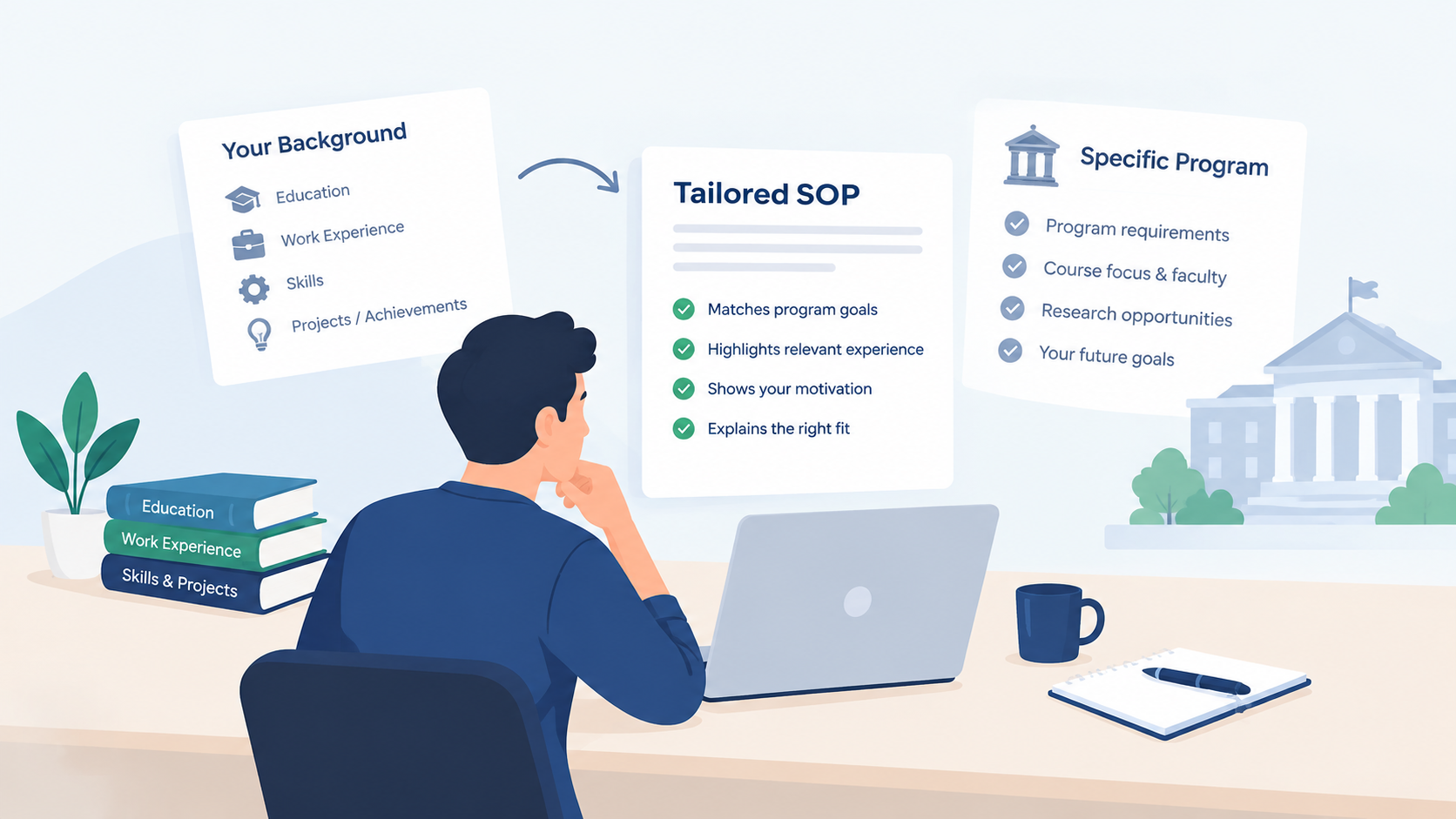
Once you understand the program, build your SOP around the connection between your background and what the course offers.
For example, instead of writing:
"I have always been interested in computer science and want to advance my career."
Explain why this particular program makes sense for your next step.
Perhaps your previous degree introduced you to a particular area, your work experience exposed you to a problem you want to understand more deeply, or a specific academic area within the program aligns with your goals.
Your SOP should make that connection clear without exaggerating your experience or claiming interests you do not actually have.
A useful structure is:
What have I done? → What did I learn? → What do I want to explore next? → Why does this program fit that direction?
Do Not Turn Your SOP Into a Template
A template can help you organize your thoughts, but it should not determine your story.
If you apply to five different programs, the factual foundation of your application may remain similar. Your education, work experience, projects, and achievements do not suddenly change. But the emphasis and program-specific reasoning should change according to what you are applying for.
The same principle applies to admission essays and statements of research. A research-focused program may require you to explain your research interests and preparation in much greater detail than a taught master's program.
Applymate AI Can Help You Tailor the Document
This is where Applymate AI can make the process more structured.
Instead of treating document writing as a generic "write me an SOP" task, Applymate's application-document flow works around the actual program you are preparing to apply for. It uses guided questions to gather the information needed for documents such as Statements of Purpose, admission essays, and Statements of Research.
That means you can work from your actual profile and the requirements of the program rather than starting with a generic template and trying to force your story into it.
Applymate also focuses on program matching before the document stage. Its approach is designed to help students identify programs based on their profile and preferences, rather than choosing a university first and figuring out eligibility afterward. You can read more about this approach in how university program matching can save time and money.
Your SOP Should Answer One Important Question
By the end of your SOP, the reader should be able to understand why you are applying to this particular program and why your background makes that choice logical.
That is difficult to achieve when the same document is reused for every application.
Your experiences are the raw material. The program requirements determine what deserves emphasis. A tailored SOP brings the two together into one coherent application document.
And if you are applying to multiple programs, having a structured way to understand each program and prepare documents around its requirements can make the process considerably more manageable.
Tags: